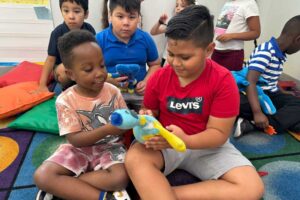

Growing Kindness
At Charity for Change, we believe kindness isn’t just a nice idea — it is a powerful skill that shapes who children become and how they influence the world around them. Emerging research supports this view, showing that kindness is much more than “being nice.” It includes compassion, generosity, gratitude, and social awareness (Warren et al., 2023).
In fact, scientists have found that children begin showing prosocial behaviors as early as eight months old — offering toys, sharing food, and comforting others (Laible & Karahuta, 2015).
As children grow and their social world expands, especially around ages 5–6 when they are starting school, they become more selective about who they help, often favoring close friends or those similar to them (Fehr et al., 2008; Hay, 2009; Olson & Spelke, 2008). School introduces many new social situations, and children are still learning how kindness fits into rules, relationships, and expectations (Eisenberg & Spinrad, 2015).
That’s exactly where the Charity for Change curriculum comes in, by teaching children to express the kindness they already feel. Young children want to help, but sometimes they struggle to show kindness effectively. Through interactive lessons, cooperative activities, and character-building experiences, we guide students to recognize kindness as a strength and a choice.
Here are three simple strategies we use (and you can too!) to help children actively practice kindness every day:
- Model and Name Kindness in Real Time
Children look to adults to understand social values. When we model helping, sharing, or including others (and point out why it matters) children begin forming a kind identity (Laible & Karahuta, 2015). - Create Daily Opportunities for Acts of Kindness
Kindness grows when practiced consistently. Small routines like greeting others, helping a classmate, writing “kindness notes,” or offering to assist a teacher make kindness feel normal and rewarding, strengthening long-term prosocial habits (Eisenberg & Spinrad, 2015). - Reflect Through Stories and Feelings
Talking about how actions affect others helps build empathy. Discussions, role-plays, and story-based conversations link kindness to emotional understanding reinforce why kindness matters (Moore, 2009).
A Kinder Future Starts with Us
Every child has the capacity to make a difference. By nurturing kindness and not just as a concept, but as a daily practice, we help children grow into compassionate leaders, thoughtful friends, and engaged community members.
Together, we are planting seeds of kindness that will continue to blossom for years to come.
🌱 Make KINDESS a central part of your classroom or afterschool program. The Charity for Change character-education curriculum is designed specifically to support elementary-aged children in becoming compassionate, respectful adults.

Karen Conley
President, CEO and founder of Charity for Change
References
- Eisenberg, N., & Spinrad, T. L. (2015). Prosocial development. Handbook of Child Psychology and Developmental Science, 1–47.
- Fehr, E., Bernhard, H., & Rockenbach, B. (2008). Egalitarianism in young children. Nature, 454(7208), 1079–1083.
- Hay, D. F. (2009). The roots and branches of human altruism. British Journal of Psychology, 100(3), 473–479.
- Laible, D., & Karahuta, E. (2015). Prosocial behavior in early childhood. In The Oxford Handbook of Prosocial Behavior.
- Moore, C. (2009). Fairness in children’s resource allocation depends on the recipient. Psychological Science, 20(8), 944–948.
- Olson, K. R., & Spelke, E. S. (2008). Foundation of cooperation in young children. Cognition, 108(1), 222–231.
- Warren, M. T., Braun, S. S., & Schonert-Reichl, K. A. (2023). A virtues approach to children’s kindness schemas. The Journal of Positive Psychology, 18(2), 149–168.