Helping Children Strengthen Self-Control: Teaching Children Tolerance in Everyday Moments
Character is learned not only through lessons but also through lived experiences. As one of life’s most essential skills, tolerance can be something children can practice every day.
At Charity for Change, we define tolerance as understanding and accepting people’s differences. This does not mean agreeing with everyone or accepting harmful behavior. Rather, it means treating others with respect and kindness, even when our viewpoints, abilities, cultures, or traditions differ.
When children learn tolerance, they gain critical tools that will support them throughout life, from friendships to their emotional well-being, to success in their future careers. Fortunately, tolerance can be learned and strengthened through everyday, simple interactions at home and in the classroom.
Why Tolerance Matters in Daily Life
Tolerance matters because it helps shape how children understand themselves before they learn to relate to others. When children feel accepted and secure in who they are, they are more open to engaging with the differences around them.
Children today are growing up learning, playing, collaborating, and interacting with peers from many different backgrounds. Our classrooms reflect the diversity of our communities, including culture, religion, language, gender, physical and intellectual abilities, learning styles, and family traditions.
When children practice tolerance, they are learning how to:
- Feel confident and secure in who they are
- Build healthy relationships
- Navigate differences without fear or judgment
- Develop empathy and emotional awareness
- Problem solve by considering multiple perspectives
Tolerance is more than just how children treat others; it’s about helping them feel safe, valued, and capable in a world full of differences.
Practical Ways to Foster Tolerance
Tolerance isn’t developed all at once. It grows through practice, and simple, everyday strategies can become powerful opportunities for growth.
Encourage Curious, Respectful Questions
Tolerance often begins with curiosity. Children naturally notice differences, and their questions are often attempts to understand the world. Instead of shutting questions down or rushing past them, parents and educators can model openness and respect by:
- Guiding children toward respectful ways of asking questions and learning.
- Responding with curiosity: “That’s a great question. What do you think about the differences?”
- Answering honestly and simply, using age-appropriate language.
When adults welcome questions, children learn that differences and curiosity are not taboo. That it is okay to notice, wonder, and learn.
Build Empathy Through Perspective
Once children begin noticing differences, it is an opportunity to help them understand how those differences are connected to real people and real feelings. Parents and educators can help foster empathy by helping children step into someone else’s shoes by:
- Using stories or conflicts to ask, “How do you think that person felt?”
- Encouraging children to identify everyone’s feelings after a conflict before working together to develop a resolution.
- Role-playing to practice kindness, sharing, and acceptance.
Pausing to consider other people’s perspectives can help children take tolerance from an idea to a genuine response.
Support Emotional Regulation
Even with empathy, tolerance can break down when emotions are running high. As adults, we know it can be difficult to respond with tolerance when we feel overwhelmed, frustrated, or overstimulated. It’s the same for children.
Parents and educators can help children learn how to regulate their emotions by:
- Teaching calming strategies such as deep breathing, counting to ten, or taking a short break.
- Helping children name their feelings and practice healthy ways to cope
- Taking a moment to acknowledge how they feel and why before responding
When children feel emotionally supported, they are better able to respond thoughtfully rather than reactively in moments of difference or disagreement.
Practice Tolerance with Play & Learning Opportunities
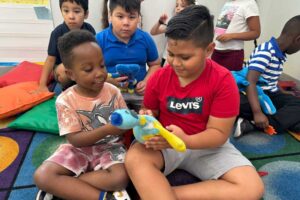
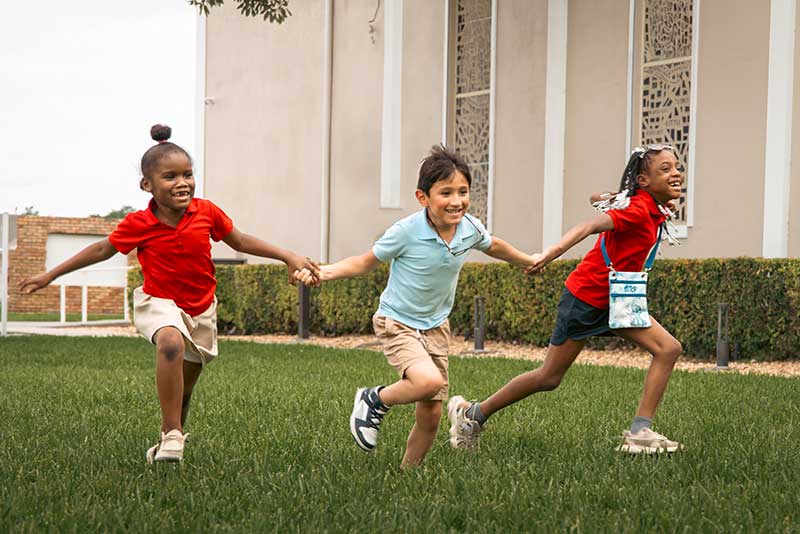
With curiosity, empathy, and emotional regulation in place, children can practice tolerance in action. Through play and collaboration in and outside the classroom, children can experience:
- Interacting with peers from different backgrounds through group projects or group play
- Games that require teamwork and collaboration
- Learn inclusive and welcoming language, such as “Do you want to play with us?” or “Let’s make sure everyone gets a turn.”
These opportunities reinforce that everyone belongs and has something to contribute.
Address Negative Behavior as a Learning Opportunity
Children are learning how to interact with new people and in new environments, so moments of negative behavior will happen. These moments are not failures; they are opportunities to reinforce the value of tolerance and guide character growth. Begin by responding calmly and without shaming, then:
- Name the behavior clearly, such as “That comment can hurt someone. Let’s talk about why.”
- Help children understand the impact of their words or actions.
- Encourage reflection and critical thinking, especially with older children.
These moments help children learn that mistakes are part of learning, and that respect and accountability go hand in hand.
A Character Trait That Lasts a Lifetime
Teaching tolerance is about more than preventing conflict; it’s preparing children to live, learn, work, and succeed in a diverse world. When children practice tolerance, they are less likely to engage in bullying and more likely to build meaningful friendships and become more resilient, especially when it comes to navigating change and uncertainty.
Each time a child chooses respect, listens with empathy, or includes someone new, they are strengthening a skill that will serve them for life.
Discover how TOLERANCE and character education can be incorporated into your classroom or after-school program. The Charity for Change curriculum is designed to support Pre-K through 5th grade students to become more resilient, compassionate adults.
Further Reading
- Bigler, R. S., & Liben, L. S. (2006). A developmental intergroup theory of social stereotypes and prejudice. Advances in Experimental Social Psychology, 38, 193-245.
- Hoffman, M. L. (2000). Empathy and Moral Development: Implications for Caring and Justice. Cambridge University Press.
- Killen, M., Mulvey, K. L., Richardson, C., Jampol, N., & Woodward, A. (2011). The accidental transgressor: Morally-relevant theory of mind. Cognition, 119(2), 197-215.
- Tropp, L. R., & Prenovost, M. A. (2008). The role of intergroup contact in predicting children’s interethnic attitudes: Evidence from meta-analytic and field studies. In S. R. Levy & M. Killen (Eds.), Intergroup attitudes and relations in childhood through adulthood (pp. 236-250). Oxford University Press.
- Borba, M. Ed.D. (2017). UnSelfie: Why Empathetic Kids Succeed in Our All-About-Me World. Touchstone.